Denver Professional License Defense Lawyer
Your professional license represents years of education, training, and career investment. When a licensing board investigation begins, whether it stems from a criminal charge, a patient or client complaint, or a mandatory self-reporting obligation, the career you have built can unravel quickly if the process is not taken seriously from the first contact. A Denver professional license defense lawyer who understands both the criminal justice system and the administrative proceedings that govern licensed professionals gives you a meaningful advantage that most attorneys simply cannot provide.
Colorado’s licensing boards operate independently from the courts, but they are deeply connected to criminal outcomes. A DUI conviction, a domestic violence charge, an assault allegation, or a drug-related arrest does not have to result in a conviction to trigger a licensing board review. In many cases, the mere existence of an investigation, arrest, or formal charge is enough to prompt mandatory self-reporting requirements that put your license in jeopardy before a single day in court. Navigating both proceedings simultaneously requires an attorney who thinks across those lines.
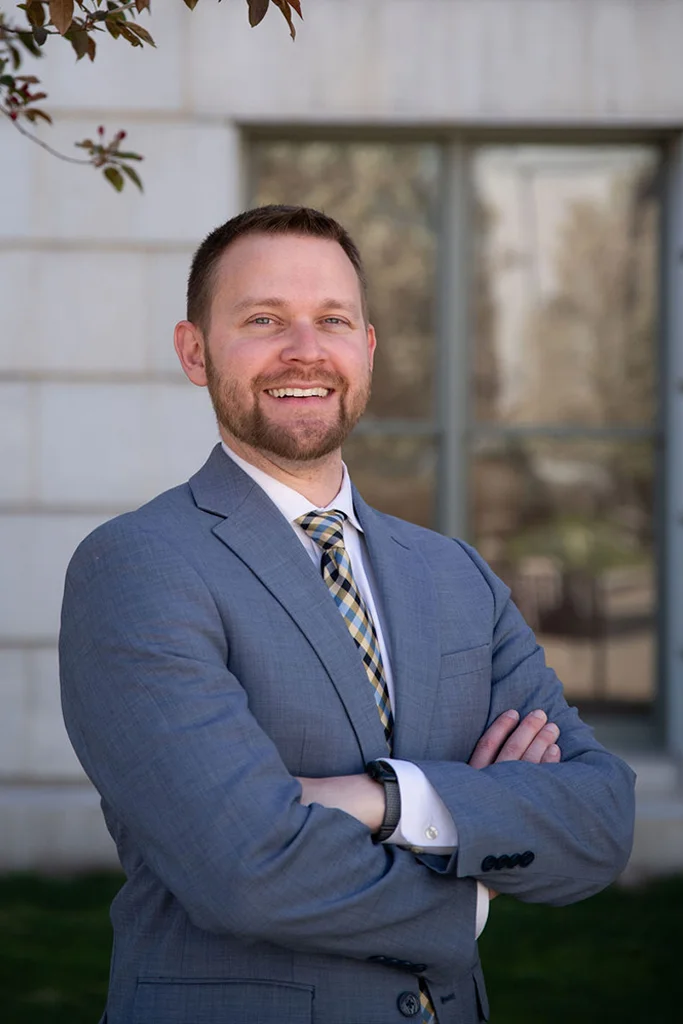
Reid DeChant has spent his career defending clients in Denver, Broomfield, Adams County, and surrounding jurisdictions against exactly the types of criminal charges that also threaten professional licenses. His background as a former public defender, combined with private practice experience spanning DUI, assault, domestic violence, drug offenses, and felony charges, makes him one of the few Denver criminal defense attorneys who can approach a licensing matter with a complete picture of what both the criminal case and the administrative proceeding will require.
Professional Licenses That Face Scrutiny After Criminal Charges or Complaints
- Medical and Clinical Licenses: Physicians, nurses, physician assistants, therapists, and other healthcare providers licensed through the Colorado Medical Board or DORA may face license suspension or revocation following criminal charges, substance-related incidents, or patient complaints alleging boundary violations, fraud, or unprofessional conduct.
- Legal Licenses: Colorado attorneys are subject to oversight by the Colorado Supreme Court’s Office of Attorney Regulation Counsel. Criminal convictions, arrests for serious offenses, or allegations of misconduct can trigger disciplinary proceedings that run parallel to any criminal case and demand immediate, coordinated attention.
- Real Estate Licenses: The Colorado Division of Real Estate investigates complaints involving fraud, misrepresentation, trust account violations, and criminal conduct. A pending criminal charge or conviction can accelerate an investigation that was already in progress or create grounds for one that would otherwise not have existed.
- Teaching and Education Credentials: Educators licensed through the Colorado Department of Education face additional scrutiny when criminal charges involve violence, substances, moral turpitude determinations, or conduct involving minors. License revocation can occur even before a final criminal disposition.
- Financial and Securities Licenses: Brokers, investment advisers, and insurance professionals regulated through Colorado’s Division of Securities or FINRA are subject to reporting requirements tied to criminal charges, not just convictions. Theft, fraud, and related financial crime allegations are treated with particular urgency by these regulatory bodies.
- Contractor and Trades Licenses: General contractors, electricians, plumbers, and other licensed tradespeople regulated through state or local licensing boards can face suspension based on fraud allegations, pattern complaints, or criminal conduct findings, particularly in connection with the Denver metro’s active construction market.
- Mental Health and Social Work Licenses: Licensed clinical social workers, counselors, and marriage and family therapists licensed through DORA’s Mental Health Unit face board review when criminal charges raise questions about fitness for practice, particularly charges involving drugs, violence, or conduct with clients.
What Reid DeChant Brings to License Defense Cases in Denver
The credential that matters most in a professional license defense case is genuine trial experience. Reid DeChant is not a lawyer who has read about cross-examining police officers or impeaching witnesses. He has done it, repeatedly, in Denver courtrooms, in front of judges and juries, across a range of charge types. As a former public defender in Denver, Broomfield, and Adams County, Reid handled an enormous caseload covering DUI, DWAI, assault, domestic violence, felony charges, sex offenses, and homicide. That breadth of criminal defense experience is directly relevant to licensing matters because the underlying criminal case and the board proceeding are intertwined.
Reid is also a graduate of the Trial Lawyers College, the program founded by Gerry Spence that trains attorneys in narrative advocacy, psychodrama, and authentic storytelling as courtroom tools. That training translates to board proceedings as well. Licensing board hearings are not passive processes. The way a licensee’s story is told, the way their professional history is framed, and the way mitigating evidence is presented to the board can mean the difference between a reprimand and a revocation. Reid’s approach, developed through that training and refined through years of actual contested proceedings, is to tell the full, honest story of his client as a person and a professional, not just a respondent in a disciplinary file.
Reid holds membership in the National Association of Criminal Defense Lawyers and the Colorado Criminal Defense Bar. These professional associations keep him current on changes in criminal law that directly affect what gets reported to licensing boards, how criminal records interact with licensing decisions, and what recent developments in expungement or record sealing law might offer a path forward for a licensed professional who has been through the system. His recognition by peer rating services reflects a practice built on results, not volume.
How Criminal Charges and License Investigations Actually Intersect in Colorado
Colorado law requires many licensed professionals to self-report criminal charges or convictions to their licensing board within a specified window, often 30 to 90 days depending on the board and the nature of the charge. Missing that deadline, or making an incomplete or inaccurate disclosure, can be treated as a separate violation on top of the underlying matter. This creates an immediate practical problem: how do you report to a licensing board without creating statements that could be used against you in the still-pending criminal case?
The answer is not to avoid reporting, and it is not to report carelessly. It is to have an attorney involved before the first communication goes to any licensing board. An attorney who handles both the criminal defense and the licensing matter can coordinate those communications carefully, timing disclosures appropriately, framing information accurately without creating unnecessary admissions, and ensuring that nothing you say to a board investigator undermines your position in the courtroom.
The Lindsey-Flanigan Courthouse handles criminal matters in Denver County, and the outcomes reached there matter to the Colorado licensing bodies that oversee Denver-area professionals. A dismissal, a not-guilty verdict, or a deferred judgment with specific terms all carry different implications for board proceedings. Reid DeChant has obtained dismissals and not-guilty verdicts in precisely the types of cases that also implicate professional licenses, including DUI cases, domestic violence charges, and assault allegations. Those criminal defense outcomes do not automatically resolve a licensing matter, but they create a fundamentally different factual foundation for a board proceeding than a conviction does.
If a board investigation has already begun independently of any criminal case, perhaps through a patient complaint, a client grievance, or an employer-initiated report, the same principles apply. Every response to a board inquiry, every document submission, and every request for a hearing or informal conference is a legal proceeding that deserves the same attention as a court filing. Responding without counsel, or with counsel who does not understand how criminal investigations and board proceedings interact, is one of the most common mistakes licensed professionals make when they first receive a board inquiry.
Your Practical Path When a License and a Criminal Case Are Both in Play
The first step is legal, not procedural. Before you respond to any board communication, before you consult your employer’s legal team, before you attempt to navigate the self-reporting question on your own, contact a Denver professional license defense attorney who handles criminal cases. The timeline matters. Many board complaints carry response deadlines of 20 to 30 days, and missing those deadlines creates additional exposure. Gathering documentation early, including your licensing history, any prior board correspondence, the incident report or criminal charging documents if available, and any communications already exchanged with the board, gives your attorney what they need to move quickly.
If you have received a summons or charging document in connection with a Denver County criminal case, that matter will be handled through the Lindsey-Flanigan Courthouse at 520 W. Colfax Avenue. Your first appearance will typically occur within days of arrest or summons. Colorado licensing complaints filed with DORA go through that department’s administrative process, which operates on its own timeline but is often monitoring the criminal case for resolution. The Colorado Division of Professions and Occupations handles complaints across dozens of licensing boards, and each board has its own procedural rules governing informal conferences, formal hearings, and the standard of proof required to impose discipline.
One of the most common mistakes is treating the criminal case and the licensing matter as separate concerns to be handled separately. They are not separate. What you say at a bond hearing, what terms you accept in a plea negotiation, and what the final disposition looks like in the criminal case all feed directly into what the licensing board sees and how they respond. A professional license defense attorney in Denver who handles both sides of this equation from the beginning keeps those moving parts coordinated in your favor.
Questions About Professional License Defense in Denver
What Colorado boards can revoke or suspend a professional license?
Colorado houses dozens of licensing boards under the Department of Regulatory Agencies (DORA), including boards for medicine, nursing, dentistry, pharmacy, mental health, social work, real estate, psychology, and many others. Each board has independent authority to investigate complaints, issue letters of admonition, impose probation, suspend licenses, or revoke them entirely. The State Board of Education handles educator credentials separately, and financial industry licenses are also governed by federal regulators alongside state oversight.
Do I have to report a DUI or DUI arrest to my licensing board in Colorado?
It depends on which board governs your license and what the specific charge is. Many Colorado licensing boards require disclosure of criminal charges, not just convictions, within a set timeframe. The Colorado Medical Board, for example, has reporting requirements tied to criminal charges. Failing to report when required can itself become a disciplinary basis. An attorney familiar with your specific board’s rules should review your reporting obligation before you submit anything.
Can a licensing board sanction me before my criminal case is resolved?
Yes. Licensing boards are not bound by the criminal timeline. If a board determines there is sufficient basis to take emergency action, such as an allegation of imminent harm to the public, it can issue a summary suspension order before any criminal case reaches a resolution. This makes it essential to engage a professional license defense attorney early, before the board has issued any formal action, rather than waiting to see how the criminal case plays out.
What standard of proof does a Colorado licensing board use?
Colorado administrative proceedings for licensed professionals typically use a preponderance of the evidence standard, meaning the board needs to find it more likely than not that a violation occurred. This is a lower threshold than the “beyond a reasonable doubt” standard in criminal cases. A not-guilty verdict in criminal court does not automatically foreclose board discipline, because the board can still find a preponderance of evidence that conduct occurred even if the criminal jury was not convinced beyond a reasonable doubt.
What happens to my license during an active investigation?
In most cases, your license remains active during an investigation unless the board takes emergency action or you voluntarily surrender it. You are generally free to continue practicing, though some employers or credentialing bodies may place restrictions on you once a board investigation becomes known. The investigation itself is typically confidential until formal charges are filed, but a board’s final action becomes a matter of public record.
If my criminal charges are dismissed, will my licensing board automatically close its investigation?
Not automatically. A dismissal of criminal charges is a significant development, and in many cases it substantially undermines a board’s ability to move forward with discipline based on the same conduct. But boards retain independent authority. Some boards will close an investigation following a dismissal with prejudice. Others will continue if the dismissal was on procedural grounds rather than a finding of factual innocence, or if the complaint raised conduct issues beyond the criminal charge itself. Your attorney should communicate the outcome and its legal significance to the board in a way that puts the strongest possible case for closing the matter.
Can I negotiate a consent agreement or settlement with a Colorado licensing board?
Yes. Many licensing investigations resolve through a stipulated agreement rather than a formal contested hearing. These agreements can take various forms, from a letter of admonition with no lasting license restriction, to probationary terms, to agreed-upon practice limitations. Negotiating these outcomes requires understanding what the board values, how similarly situated licensees have been treated, and what terms your professional life can accommodate. An attorney with administrative hearing experience can assess whether a proposed consent agreement is reasonable or whether contesting the matter would produce a better outcome.
How does a prior criminal record affect a Colorado licensing application or renewal?
Colorado has taken steps to limit automatic disqualification of license applicants based solely on prior criminal history. However, boards retain the authority to consider criminal history when it is substantially related to the duties of the licensed profession. Prior convictions for offenses involving fraud, violence, substance abuse, or conduct directly tied to the professional role are more likely to trigger scrutiny on application or renewal than unrelated offenses. An attorney can help applicants with prior records prepare a disclosure that presents the full context and mitigating factors in a way that gives the application the best chance.
What is a “moral turpitude” finding, and how does it affect my license?
Some Colorado licensing statutes authorize boards to impose discipline based on a conviction or finding involving moral turpitude, a legal term historically applied to conduct considered fundamentally dishonest or depraved. The scope of what qualifies varies by board and context. Theft, fraud, crimes involving dishonesty, and some violent offenses have been treated as moral turpitude matters in licensing proceedings. The term is fact-specific and contested, and an experienced professional license defense attorney can challenge whether particular conduct meets this standard under the governing statute.
Should I hire separate lawyers for the criminal case and the licensing matter?
For many licensed professionals, having a single attorney who understands both dimensions is more effective than splitting the representation. Coordination between the criminal defense strategy and the licensing board response is essential. If the criminal case involves specific admissions, plea terms, or diversion agreements, those terms can have direct licensing consequences that only an attorney working across both proceedings would catch in advance. When one lawyer handles the criminal case without knowledge of the licensing implications, opportunities to structure outcomes favorably for both proceedings can be missed.
Denver Professional License Defense Across the Metro Region
DeChant Law represents licensed professionals facing criminal charges and board investigations across the Denver metropolitan area and surrounding communities. From clients working in the medical district near Colorado Boulevard and the Anschutz Medical Campus in Aurora, to professionals employed in the downtown Denver legal and financial corridor, to tradespeople licensed for projects across the Front Range, Reid DeChant handles licensing-related criminal matters wherever they arise in this region.
Representation extends across Denver proper and into the surrounding communities where many licensed professionals live and work, including Aurora, Lakewood, Westminster, Thornton, Arvada, Wheat Ridge, Englewood, Littleton, Centennial, Parker, Castle Rock, Brighton, Commerce City, and Broomfield. Cases arising in Jefferson County, Arapahoe County, Adams County, Douglas County, and Broomfield County all fall within the geographic scope of this practice. Reid has litigated criminal cases in courthouses across all of these jurisdictions, giving him direct familiarity with the local courts whose outcomes feed into licensing board proceedings.
Whether you are a healthcare provider in Greenwood Village, a contractor working across the Denver metro, a teacher in Thornton, a financial professional in Centennial, or an attorney practicing downtown, the intersection of a criminal matter and a licensing obligation requires coordinated attention from a lawyer who operates across all of those geographic and institutional lines.
Denver Professional License Defense Attorney Ready to Help
A licensing board investigation is not something to manage on your own, and it is not something to hand off to a general attorney who has never been inside the administrative proceedings that govern licensed professionals in Colorado. Reid DeChant is a Denver professional license defense attorney with the criminal defense depth and administrative understanding to handle both sides of these cases from day one.
If you have received a board complaint, a notice of investigation, or a criminal charge that could trigger reporting obligations or licensing consequences, contact DeChant Law directly to discuss your situation. The earlier Reid is involved, the more options exist for managing the outcome. Do not wait for the criminal case to resolve before addressing the licensing implications. Call today to schedule a consultation.