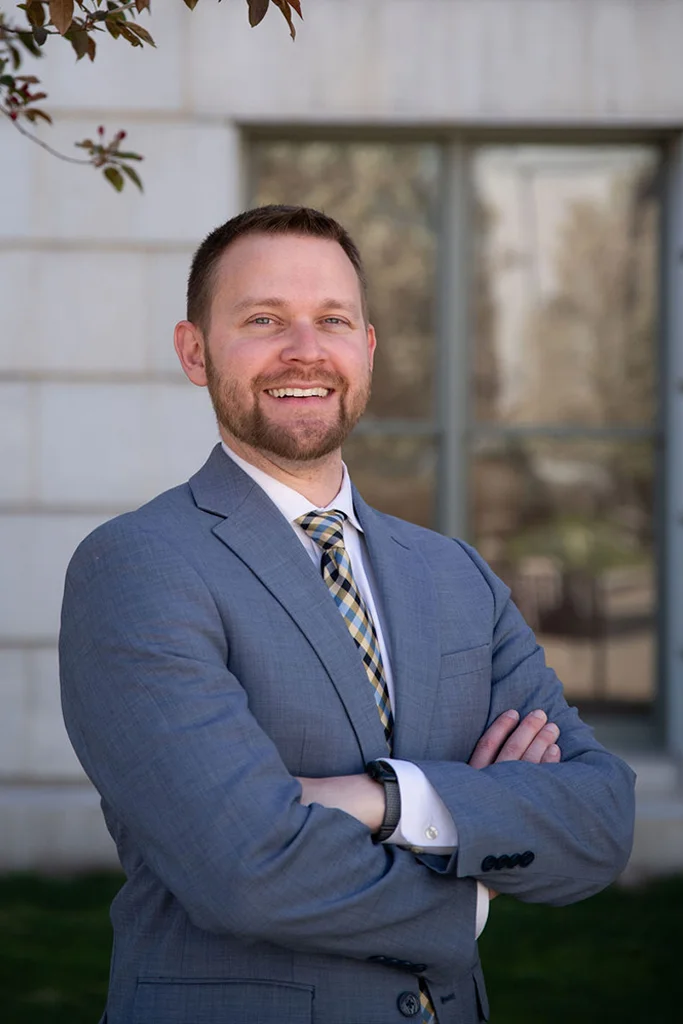

Weld County Felony Lawyer
A felony charge in Weld County carries consequences that extend well beyond the courtroom. Prison time, steep fines, loss of voting rights, firearm restrictions, and a permanent criminal record that follows you into every job application and housing search. Reid DeChant at DeChant Law handles felony defense for clients throughout the Weld County area, bringing experience from both public defender work and private practice across the Front Range. His background includes defending violent offenses, drug charges, sexual assaults, and homicides, which means he has worked through the full range of what Colorado’s felony statutes can put in front of a client.
How Weld County Prosecutes Felony Cases
The Weld County District Attorney’s Office, based in Greeley, has a reputation for prosecuting felonies aggressively. Cases originating from Greeley, Longmont, Evans, Fort Lupton, and surrounding communities all funnel through the 19th Judicial District. That court system has its own procedural rhythms, its own prosecutorial tendencies, and its own judges, and understanding how they operate shapes every strategic decision a defense attorney makes.
Weld County sees a significant volume of agriculture and oil and gas industry workers, and cases involving DUI (including felony DUI on a third or fourth offense), assault in workplace or rural settings, drug trafficking, and domestic violence charges arise with regularity. Crimes in incorporated areas like Greeley and Evans often involve Greeley Police Department or Evans Police Department investigations, while crimes in unincorporated parts of the county involve the Weld County Sheriff’s Office. The agency that investigates the case affects what discovery looks like, which officers will testify, and what video or forensic evidence might exist.
Colorado classifies felonies from Class 1 through Class 6, with Class 1 carrying the most severe penalties. Felony charges in Weld County can also trigger mandatory sentencing provisions, habitual offender enhancements, or extraordinary aggravating circumstances that push sentences well above the standard range. The difference between how a charge is filed, whether a plea is negotiated, and how a case is tried can mean years of someone’s life.
What Actually Drives the Outcome in a Felony Case
Felony defense is not a single strategy applied uniformly. What matters depends heavily on the specific charge, the evidence the prosecution holds, the client’s prior record, and what happened at the investigation stage before an attorney was ever involved. There are recurring pressure points worth understanding.
Evidence suppression is often the first serious question in a felony case. If law enforcement conducted a warrantless search, exceeded the scope of a warrant, or obtained a confession without proper advisements, the resulting evidence may be suppressible under the Fourth and Fifth Amendments. Suppression of a key piece of evidence does not always end a case, but it can fundamentally change what the prosecution can prove and what outcome is realistically available.
Witness credibility is another lever. In assault cases, domestic violence cases, and crimes involving allegations from a single accuser, cross-examining that witness effectively at trial can determine everything. Reid trained at Trial Lawyers College, where the focus is on storytelling in the courtroom and connecting juries to the human reality of a client’s situation. That kind of trial preparation is not cosmetic. It is the difference between a lawyer who files motions and a lawyer who can actually win in front of twelve people.
Plea negotiations matter too, and not all defense attorneys approach them with the same leverage. A prosecutor who knows the defense attorney has no meaningful trial record will offer less. A prosecutor who has faced the attorney in court, or knows they are willing to take a case to verdict, negotiates differently. The credibility a defense attorney brings to the negotiation table is built in courtrooms, not in settlement letters.
Felony Classes and What They Mean for Sentencing in Colorado
Colorado’s felony sentencing grid matters because it determines the range of prison time and fines a judge can impose. A Class 6 felony, which is the least severe, carries a presumptive range of 12 to 18 months in prison and fines between $1,000 and $100,000. A Class 2 felony carries 8 to 24 years in prison. Class 1 felonies, which include first-degree murder, carry life in prison or the death penalty. Between those extremes sit Class 3, 4, and 5 felonies, each covering a wide range of offenses from drug distribution to certain assault charges to burglary and theft above specific dollar thresholds.
Some felonies are classified as extraordinary risk crimes under Colorado law, which extends the maximum sentencing range beyond the standard presumptive range. Crimes like second-degree assault, child abuse, and certain drug offenses fall into this category. A client and their attorney need to know at the outset whether the charged offense carries that enhancement, because it affects everything from plea evaluation to whether a case should proceed to trial.
Colorado also has habitual criminal statutes. A defendant with prior felony convictions can face mandatory sentencing enhancements that remove the judge’s discretion entirely. If prior convictions are part of a client’s record, the defense strategy has to account for that reality from the very beginning of the case.
Questions Worth Asking About a Felony Charge in Weld County
What happens at an arraignment in the 19th Judicial District?
Arraignment is the court appearance where you are formally advised of the charges and asked to enter a plea. In Weld County, you will appear in the district court in Greeley. Bail conditions, including bond amounts and any conditions of release, are typically set at or before this hearing. Having an attorney present from this point forward affects the bond argument and prevents any missteps in how the initial plea is handled.
Can a felony charge be reduced to a misdemeanor?
Yes, in some cases. Prosecutors have charging discretion, and defense attorneys can negotiate to have felony charges amended or reduced, particularly where the evidence has weaknesses, the client has no significant prior record, or the facts of the case fall close to the boundary between felony and misdemeanor classifications. Whether this is realistic depends entirely on the specific charge and facts, not on any general rule.
How long does a felony case in Weld County typically take?
It varies considerably. A case that resolves with a plea can conclude within a few months. A case that proceeds to trial, involves complex forensic evidence, or requires pretrial litigation over suppression motions may take a year or more. Speedy trial rights under Colorado law provide some structural limits, but those rights can be waived strategically when more time benefits the defense.
Does a felony conviction automatically mean prison?
Not always. Colorado allows probation for many felony offenses, particularly Class 4, 5, and 6 felonies and first-time offenders. The judge has discretion within the sentencing range, and the arguments made at sentencing, including mitigating facts about the client’s background, employment, community ties, and the circumstances of the offense, can have a real effect on the outcome.
What if the arrest involved a search that felt unlawful?
That question is worth exploring with an attorney immediately. Fourth Amendment suppression issues must typically be raised through a pretrial motion. If evidence was obtained through an unlawful stop, search, or seizure, it may be possible to exclude it from the prosecution’s case. The analysis depends on the specific facts of how law enforcement conducted themselves, which is why a thorough review of the police reports and body camera footage matters early in the case.
Can a felony conviction be sealed in Colorado?
Some felony convictions are eligible for sealing under Colorado’s record sealing statutes, depending on the offense class and the waiting period after the case concludes. Not all felony convictions qualify, and the eligibility rules are specific. This is worth discussing as part of understanding the full picture of what a plea or conviction would mean long-term.
Does it matter whether the charge is a drug felony versus a violent felony?
Significantly. Drug felonies in Colorado are often subject to different sentencing considerations, diversion options, and treatment-based alternatives than violent offenses. Colorado has made legislative changes in recent years that affect drug felony classifications and penalties. Violent felonies, particularly those involving weapons or serious bodily injury, carry mandatory minimums and restrictions on probation eligibility that drug cases typically do not.
Facing a Weld County Felony Charge? Here Is What Reid DeChant Brings to the Defense
Reid DeChant’s record includes not-guilty verdicts at trial in assault cases, DUI cases, domestic violence cases, and sex offense cases. He secured dismissals through successful motion practice and DMV hearing wins. That track record is not offered as a guarantee of future results; Colorado law does not permit that. What it reflects is a lawyer who has actually tried felony-level cases and knows what effective preparation looks like from investigation through verdict. If you are navigating a Weld County felony case and want to talk through where things stand and what the realistic options are, DeChant Law is available to evaluate the facts and give you a straight answer about what defense looks like for your situation.