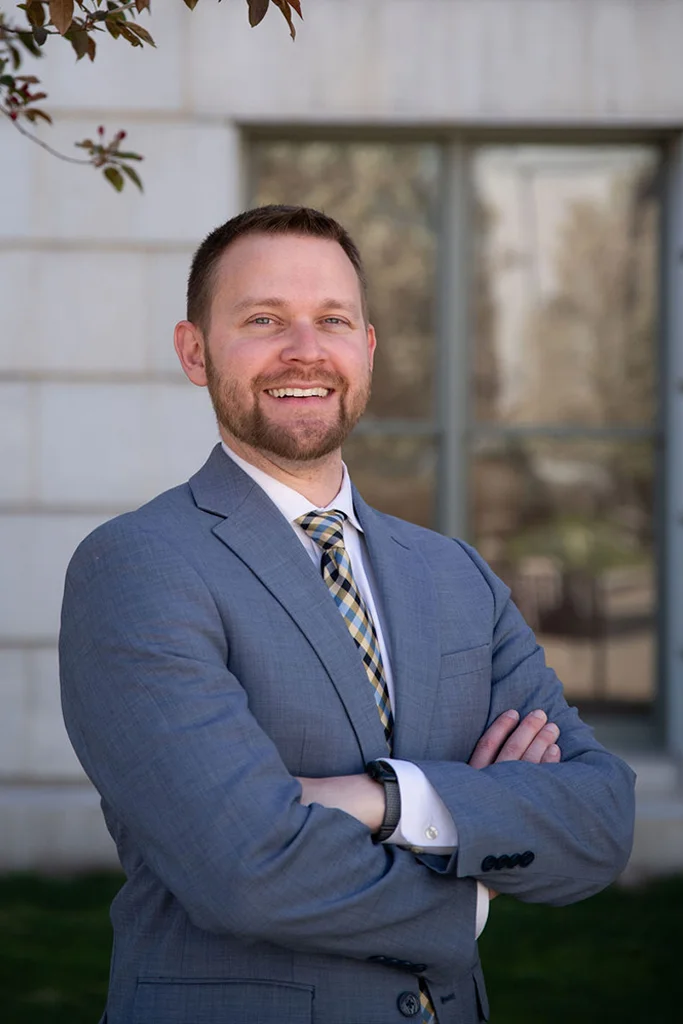
Denver Student Defense Lawyer
A university disciplinary hearing and a criminal charge can happen at the same time, triggered by the same incident, governed by entirely different rules, and capable of producing consequences that follow a student for decades. Denver student defense lawyer Reid DeChant understands both systems and how the choices made in one can affect the outcome of the other. At DeChant Law, that dual awareness is not a talking point. It is the foundation of how these cases are actually handled.
Two Systems, One Incident: How Student Cases Differ From Standard Criminal Cases
A student accused of assault at a campus party, drug possession in a dormitory, or a DUI after a night near the Auraria campus faces overlapping jeopardy that most defense attorneys are not trained to manage simultaneously. The university moves quickly under its own code of conduct. The criminal case moves through the county court system on a separate track. Neither body is bound by the other’s outcome, which means an admission made to a campus conduct officer can surface in a criminal proceeding and vice versa.
Colorado’s colleges and universities, including the University of Denver, Metropolitan State University, Community College of Denver, and the institutions on the Auraria campus, each maintain their own student conduct processes. Those processes are not courts of law. Evidentiary rules that would exclude certain statements in a criminal courtroom may not apply in a campus hearing. The burden of proof is typically lower, often a preponderance of the evidence standard rather than proof beyond a reasonable doubt. And the hearing officers making decisions are university employees, not neutral judges.
None of that makes a campus hearing informal or inconsequential. A finding of responsibility can trigger suspension, expulsion, a permanent notation on an academic transcript, loss of housing, and loss of financial aid. For graduate students, professional school applicants, and anyone planning a career in law, medicine, education, or finance, a university disciplinary record can disqualify them from licensing or employment before the criminal case even concludes.
Criminal Charges That Commonly Arise in Student Contexts
The charges most commonly associated with student defense cases in Denver tend to cluster around a few recurring fact patterns. Each has its own evidentiary terrain and its own range of outcomes depending on how the case is handled from the beginning.
Alcohol-related charges are the most frequent. DUI and DWAI arrests involving students often occur near entertainment districts close to campus, on Colfax Avenue, in the Capitol Hill area, or along the corridors that connect dormitory neighborhoods to bars and restaurants. For students under 21, the threshold is far lower than the standard 0.08% BAC. A BAC of 0.02% or higher can result in an underage drinking and driving charge. Beyond the criminal penalties, a DUI conviction can jeopardize campus housing, scholarships tied to good standing requirements, and professional licensing in fields the student is training to enter.
Drug possession charges arise frequently in campus housing and at off-campus gatherings. Although Colorado has legalized recreational marijuana, possession remains regulated by age and location, and federal financial aid programs are governed by federal law, which still classifies marijuana as a controlled substance. A conviction, even for a minor possession offense, can trigger a period of financial aid ineligibility under federal rules, which is a consequence many students and families do not anticipate.
Assault charges, including those involving domestic violence designations, are a category where the stakes escalate sharply. Mandatory arrest policies in Colorado mean that a physical altercation, even one both parties later describe as minor, can result in an arrest with a domestic violence designation attached. That designation triggers a mandatory protection order, which can prohibit a student from returning to shared campus housing or accessing certain campus facilities while the case is pending. Reid has obtained not-guilty verdicts at trial on assault and domestic violence charges and understands how these cases need to be built from the initial investigation forward.
Other charges that come through student defense cases include harassment, theft, trespass, and charges arising from campus protests or demonstrations. The specific facts of each matter, but the consistent thread is that early legal involvement changes the range of outcomes available.
What Actually Happens in a Denver County Court Student Case
Criminal charges arising from incidents in the Denver metro area flow through different courts depending on where the arrest occurred. Cases from incidents near the Auraria campus or within Denver city limits proceed in Denver County Court for misdemeanors or Denver District Court for felonies. Incidents in Aurora or near the University of Denver may fall under Arapahoe County jurisdiction. Arrests in the Westminster or Broomfield area near Front Range Community College go through different venues still.
Reid has handled cases across these jurisdictions as both a public defender and in private practice. That courtroom familiarity matters in student cases because prosecutors and judges see these fact patterns regularly. The difference between a resolution that protects a student’s record and one that does not often comes down to how the case is framed, what evidence is challenged, and whether the attorney trying the case has the trial experience to make the prosecution’s path to conviction genuinely difficult.
Colorado’s deferred judgment and diversion programs are particularly relevant in student cases. For first-time offenders, a successful deferred judgment can allow the charge to be dismissed upon completion of conditions, and the record may then be eligible for sealing. That outcome is not available in every case, and not every charge qualifies, but identifying early whether a student is eligible for these pathways is one of the first questions to resolve.
Questions Students and Families Actually Ask
Can the university discipline a student if the criminal charges are dropped?
Yes. University disciplinary proceedings are independent of the criminal justice system. A dismissal of criminal charges, or even a not-guilty verdict at trial, does not bind the university. The campus conduct process applies its own standard of proof, gathers its own evidence, and can reach its own conclusion. This is why the two tracks need to be managed together, not sequentially.
Should a student speak with campus officials or university investigators without an attorney present?
No. A student is generally not required to cooperate with a university investigation beyond what the institution’s specific policies mandate. Statements made to a resident advisor, dean of students office, or campus security can be used in both the university proceeding and, in some circumstances, shared with law enforcement. The right course of action depends on the specific facts, but speaking with an attorney before making any statements to anyone is almost always the correct first step.
Will a DUI charge automatically affect a student’s financial aid?
Not automatically for alcohol, but a drug conviction can trigger a federal financial aid suspension under the Higher Education Act. The specific impact depends on the type of conviction, whether it is a first offense, and whether the student is receiving federal aid. A deferred judgment or diversion outcome that avoids a final conviction may preserve eligibility, which is one more reason the form of resolution matters as much as the outcome itself.
What happens to a student’s visa status if they are charged with a crime in Colorado?
International students on F-1 or other student visas face immigration consequences that a domestic student does not. Certain convictions can trigger removal proceedings or prevent future visa renewal. This dimension of the case needs to be identified immediately, and any plea or resolution needs to be evaluated against its immigration consequences before anything is accepted.
Can a university expel a student before the criminal case is resolved?
Yes. Universities can impose interim suspensions or begin expulsion proceedings independently of the criminal timeline. In cases involving allegations of violence or sexual misconduct, interim restrictions often go into effect almost immediately. Challenging those interim measures and protecting a student’s ability to continue coursework while the matter is pending is often as urgent as the long-term defense strategy.
How long does a student conduct violation stay on an academic transcript?
It depends on the institution and the nature of the finding. Some universities permanently annotate transcripts following an expulsion. Others have processes for removing notations after a period of time. Graduate schools, bar applications, and medical licensing boards regularly request academic transcripts, and an unexplained disciplinary notation will almost always prompt questions that are difficult to answer without context.
Is it possible to seal a criminal record related to a student charge in Colorado?
Colorado’s record sealing statutes allow certain arrests and convictions to be sealed so they no longer appear in standard background checks. Eligibility depends on the charge, the disposition, and the amount of time that has passed. For many student cases that resolve through deferred judgment or dismissal, record sealing is available. That process is something Reid can evaluate alongside the defense of the underlying charge.
Student Defense in Denver Requires a Lawyer Who Tries Cases
A student facing charges in Denver deserves representation from a Denver student criminal defense attorney who has actually stood up in court, cross-examined witnesses, and delivered verdicts. Reid DeChant has done exactly that across Denver, Adams County, Arapahoe County, Jefferson County, and Broomfield County. His background as a public defender handling everything from traffic offenses to serious felonies, combined with focused DUI defense experience and trial training at Trial Lawyers College, shapes how he approaches every case. The goal is always the outcome that best protects what comes next for the student, not simply the fastest resolution. Reach out to DeChant Law to have a direct conversation about what the case actually involves.